
Elmhurst Epoxy Flooring builds epoxy garage floors in Elmhurst, IL, serving surrounding cities including Northlake, Bellwood, Bensenville, Franklin Park and Westchester. With 20+ years on concrete, we approach a garage as a slab problem first and a color choice second, because a floor that looks great in October and lifts by March was decided long before anyone picked a flake blend.
Every garage we coat is ground with diamond tooling or shot blasted to a measured profile, tested for moisture, and repaired where it is cracked or spalled. The proposal you sign names the coating line, the number of coats and the finished thickness, so you can check the floor you get against the floor you were promised.
We also name the limits up front. A garage coating will not stop water coming up through a slab, will not cure properly on frozen concrete, and will not survive a crack that is still moving. Telling you that before the job is sold is cheaper for everyone than discovering it after.
Our Step-by-Step Epoxy Garage Floor Process
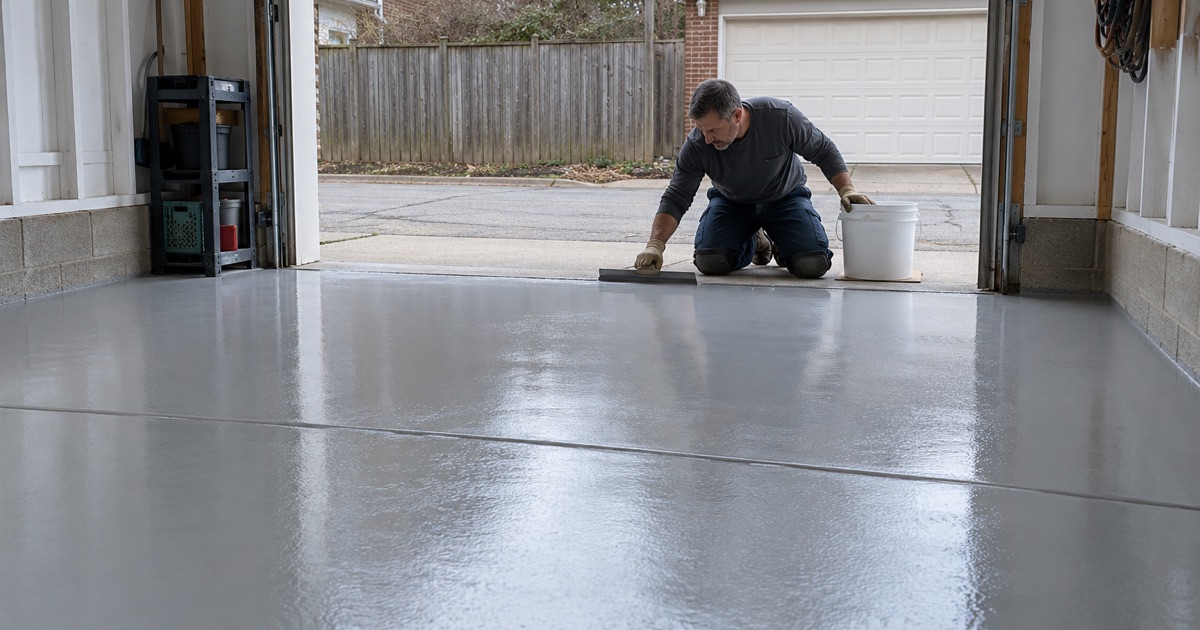
Step 1: Slab Assessment and Moisture Test
We start by walking the slab with you, mapping every crack, spall, oil stain and patch, and noting where water pools near the door or the drain. A calcium chloride test under ASTM F1869 or relative humidity probes under ASTM F2170 tell us how much vapor the slab is pushing, and that number is written into the scope before the price is final.
This is also when we ask about the house. Whether the garage is attached or detached, how old the slab is, and whether it has ever been sealed or painted all change which primer and which repair materials make sense, and it is far cheaper to learn that on a clipboard than halfway through a grind.
Step 2: Diamond Grinding With Dust Capture
The whole floor is ground to an ICRI concrete surface profile that suits the system, usually a texture you can feel like coarse sandpaper. Our grinders run with vacuums attached at the head, so dust is captured at the machine rather than swept out the door or washed toward the driveway and storm inlet.
Grinding also removes the weak top layer of paste, curing compounds and old sealers. That layer is exactly what peels away under a coating applied over an etched or merely washed floor.
Step 3: Crack, Spall and Joint Repair
Dormant cracks are routed open and filled with a rigid repair material, spalls are rebuilt, and pitting from past winters is skim-filled and ground flush. Control joints are either filled or honored, depending on whether the slab is still moving. If a section is heaving or broken through, we stop and say the slab needs work before it should be coated.
Step 4: Primer, Body Coat and Broadcast
A penetrating primer or a moisture-mitigation primer goes down first, chosen from the test result. The body coat follows, typically a 100% solids epoxy, and colored vinyl flake or quartz is broadcast into it while wet. Once it cures, the loose excess is scraped and vacuumed so only locked-in chips remain.
Step 5: Topcoat and Cure Schedule
A clear polyaspartic or urethane topcoat seals the broadcast, sets the sheen and carries the abrasion resistance. We time each coat by slab temperature and the dew point spread at the surface, not by the clock, which is how amine blush and soft spots are avoided. You get walk-on and drive-on dates in writing.
Garage Floor Coating Systems We Install
Full-Broadcast Flake With a Polyaspartic Topcoat
This is the system most Elmhurst homeowners choose for a two-car or three-car garage: an epoxy body coat saturated with vinyl flake, then a clear polyaspartic topcoat. The chips hide dust and tire marks, add texture underfoot and disguise repaired cracks, while the topcoat stays clear under daylight from an open overhead door.
Chip size and blend change the look more than most people expect. A fine chip in a gray blend reads almost like stone, while a larger chip in a high-contrast blend reads busier and hides more.
Solid Color Epoxy With Quartz Texture
For a workshop garage or a hobby bay, a solid color coating with a fine quartz aggregate in the topcoat gives a clean, bright floor that is easy to sweep and easy to find a dropped bolt on. The texture is set by the grit size we specify, so the floor has grip under wet boots without being hard to mop.
Metallic Epoxy for Show Garages
Metallic epoxy creates a marbled, three-dimensional look that suits a collector car garage or a finished space used more as a room than a parking spot. It demands a flatter slab and tighter temperature control than a flake system, and it shows tire scuffs more readily. We tell you that before you choose it, not after.
What an Elmhurst Winter Puts a Garage Floor Through
Brine, Slush and Calcium Chloride
Every car that pulls in from a salted road drips brine onto the floor, and calcium chloride and rock salt left on bare concrete feed scaling and surface pitting through the freeze-thaw season. A sealed, coated slab keeps that chloride on the surface, where it can be squeegeed out instead of soaking in.
Hot Tire Pickup After a Summer Drive
Tires coming off hot pavement can soften a thin, poorly bonded coating enough to lift it as the car pulls away. The cure is a ground profile, a high-solids body coat with real thickness, and a topcoat rated for the job. We build every garage system to resist it, not just to look good on day one.
Unheated Slabs and Winter Scheduling
An unheated garage slab in January can sit well below the minimum temperature a coating needs to cure. Rather than coat it anyway and hope, we read the slab and dew point and push the job to a warmer window when the numbers say so. A floor coated too cold can stay soft, cloud over or fail to bond.
Attached Garage Slabs and the City’s Vapor Barrier Rule
Under its adopted 2021 International Residential Code, Elmhurst requires a 6-mil vapor barrier under attached-garage slabs, sloped toward the overhead door rather than to a drain, and leaves detached garages out of the barrier rule. Older attached garages may predate the requirement, so we never assume a barrier is there; the moisture test decides the primer.
Beyond the Single-Family Garage
Condominium and Apartment Parking Garages
Shared garages under condominium and apartment buildings face the same salt and tire load as a home garage, multiplied across dozens of stalls. We phase the work in sections so residents keep somewhere to park, coordinate notices with the building manager, and stripe stalls and drive aisles once the coating cures.
Parking decks and garages under occupied buildings also carry drains, ramps and expansion joints that a single-family slab does not. Each of those details is drawn into the proposal before work starts, so the association board can approve a scope it can actually hold the crew to.
Fleet Bays and Auto Repair Garages
Service bays and fleet garages add hot oil, brake fluid, dropped tools and jack stands to the usual salt and tire wear. These floors get a thicker epoxy build and a chemical-resistant topcoat, with texture added where fluids spill. Scheduling can follow your slow days so bays come back into service one at a time.
- 20+ Years on Concrete
- Moisture Testing in Every Scope
- Ground, Never Acid-Etched