
Elmhurst Epoxy Flooring installs ESD flooring in Elmhurst, IL, serving surrounding cities including Northlake, Bellwood, Bensenville, Franklin Park and Westchester. Electrostatic discharge can damage electronic components and ignite flammable vapors, and a properly installed static-control floor is one of the most reliable ways to manage it. Our 20+ years of slab preparation and resin floor work are the foundation every ESD floor depends on.
An ESD floor is not a coating with a special label. It is an engineered, grounded system that must measure within a specific electrical resistance range, installed over a properly prepared slab and maintained with compatible products. Get any part of that wrong and the floor can test out of range, even if it looks perfect.
Our proposals name the system, the target resistance range, the grounding layout and how the floor will be tested at handover. That gives your quality team a written specification to check the floor against, and a baseline for every test that follows.
What ESD Flooring Does
Controlling Static Discharge
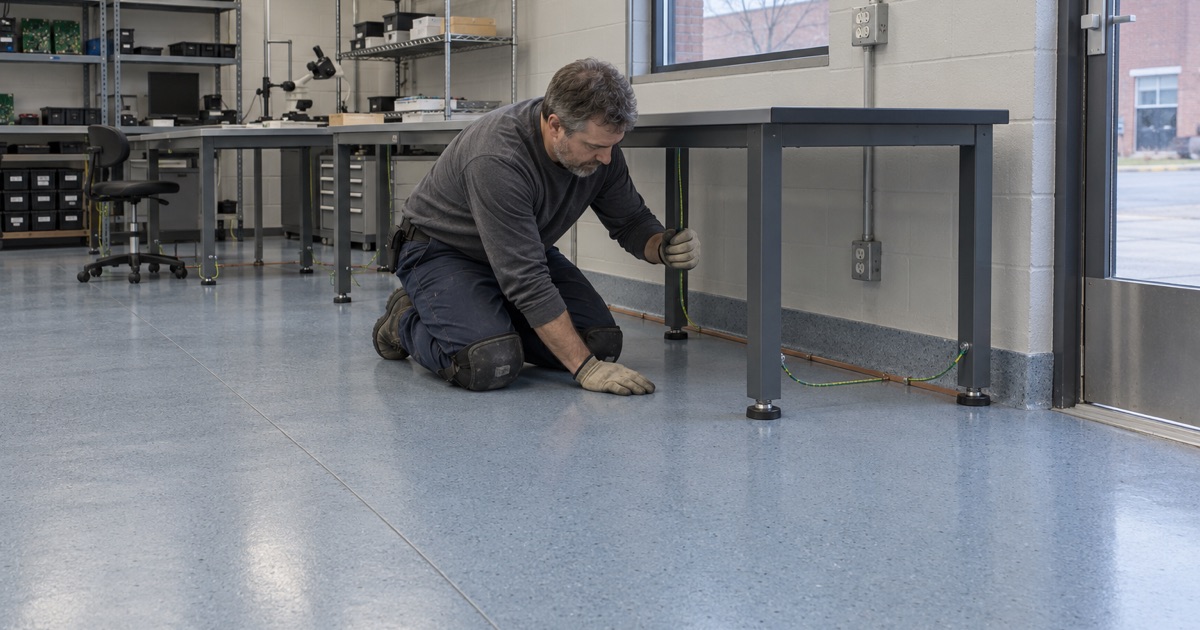
People build up static charge as they walk, especially in dry winter air. When that charge discharges into a circuit board or sensitive component, it can cause immediate failure or hidden damage that shows up later. A static-control floor gives that charge a controlled path to ground, so it drains away safely rather than jumping to equipment.
Chicago-area winters make this more pressing. Heated indoor air in January is dry, and dry air lets charge build faster and higher than it does in a humid summer. A floor that tests well in August needs to perform just as well when the heating season drives humidity down, which is why the specification, not the season, sets the target.
The Floor Is Part of a System
The floor only works together with grounded footwear, grounded work surfaces and wrist straps where required. ANSI/ESD S20.20 sets the framework many electronics programs follow; the program’s aim is that a person wearing approved, grounded footwear cannot generate over 100 volts on the body. The floor’s resistance and the footwear’s resistance are tested together to confirm it.
Where Static-Control Floors Are Needed
Static-control flooring is used in electronics assembly and repair, data and server rooms, laboratories, medical imaging and diagnostic areas, and spaces where flammable materials are handled. If your customers or your quality program require static control, the floor specification usually comes from them, and we build to it.
A static-control floor can cover a whole building or just one room. Many facilities only need it in an assembly cell, a repair bench area or a server room, with a standard epoxy elsewhere. We map the protected areas with you, mark the transitions and keep the grounding layout limited to where it is actually needed.
Conductive Versus Static-Dissipative Floors
Static-Dissipative Floors
A static-dissipative floor measures at or above 1.0 x 10^6 ohms and below 1.0 x 10^9 ohms. It drains charge at a controlled rate, which suits most electronics assembly, testing and repair areas. This range is the most common specification for manufacturing and service environments.
Conductive Floors
A conductive floor measures below 1.0 x 10^6 ohms and drains charge more quickly. It is specified where faster discharge is needed, such as some explosive or highly sensitive environments. Because conductive floors carry charge readily, the electrical design of the space and personnel safety must be considered alongside the floor.
Choosing the Right Range
The right range depends on what you handle, your customers’ requirements and your static-control program. ANSI/ESD S20.20 asks that floors used as the primary grounding path for people measure below 1.0 x 10^9 ohms. We work from your program’s specification rather than choosing a range on our own.
How an ESD Floor Is Installed
Slab Preparation and Moisture Testing
The slab is diamond ground or shot blasted to the profile the system requires, cracks and joints are repaired, and moisture is tested with calcium chloride kits or in-situ relative humidity probes. Excess moisture can affect both the bond and the electrical performance, so a moisture-mitigation primer is added where results call for it.
Grounding Strips and Conductive Primer
Copper grounding strips are laid out on the primed slab and connected to building ground at specified points. A conductive primer goes over them, creating a continuous layer that collects charge from the surface above and carries it to the grounding strips. The layout is designed for the room size and the number of ground points needed.
We document where each ground connection is made, so maintenance staff and future contractors know where they are. Grounding points that are buried without a record are easy to damage during later renovations.
ESD Body Coat and Topcoat
A static-dissipative or conductive epoxy body coat is applied over the conductive primer, followed by a compatible topcoat if the system calls for one. These products contain conductive materials distributed evenly through the resin, and they must be mixed and applied to the manufacturer’s thickness to land in range.
Too thin a coat can leave spots that read too conductive, and too thick a coat can push resistance higher than the target. Our crews check wet film thickness as they work and keep mixing and application consistent across the room, because uneven coverage is the most common reason a new static-control floor tests out of range.
Acceptance Testing at Handover
Once cured, the floor is tested with a resistance meter according to the specified method, with readings taken across the room and recorded. ANSI/ESD STM7.1 is the common method for floor resistance. You receive the readings as a baseline for your program, and any area that measures out of range is corrected before handover.
Keeping an ESD Floor in Range
Cleaning and Maintenance
Everyday cleaning keeps an ESD floor working, but the wrong products can ruin its performance. Standard waxes, polishes and some cleaners leave insulating films that raise resistance. We provide a maintenance guide listing approved cleaners and methods, and recommend that cleaning staff are briefed before the floor goes into service.
Periodic Testing and Repairs
Wear, damage and contamination can change a floor’s resistance over time. Regular testing catches problems early, and damaged areas can be repaired with compatible ESD materials. After any repair or recoat, the area is retested to confirm it remains within range.
Footwear and Personnel Grounding
Because the floor works with footwear, your program should include conductive or dissipative shoes or heel grounders, and a way to check them at entry. A perfect floor provides no protection to a person standing on it in ordinary rubber-soled shoes.
- 20+ Years on Concrete
- Moisture Testing in Every Scope
- Ground, Never Acid-Etched