
Elmhurst Epoxy Flooring installs basement floor epoxy in Elmhurst, IL, serving surrounding cities including Northlake, Bellwood, Bensenville, Franklin Park and Westchester. In 20+ years of coating basements we have learned that the most important decision on a basement job happens before any coating is opened: whether this slab, in this house, is dry enough to hold one.
A basement floor sits against soil on every side, and the ground under it holds moisture year round. A coating that bonds well in a dry garage can blister, peel or turn cloudy on a basement slab that pushes vapor, and no topcoat or warranty changes that. So every basement we quote starts with a moisture test and a careful look at the room’s water history.
When the test and the history say yes, a coated basement floor is easy to clean, resists spills and stains, and brightens a space that bare concrete or old paint leaves gloomy. When they say not yet, we tell you what needs to happen first, whether that is plumbing, drainage, drying time or a moisture-mitigation primer.
Reading a Basement Before Coating It
Signs of Past Water
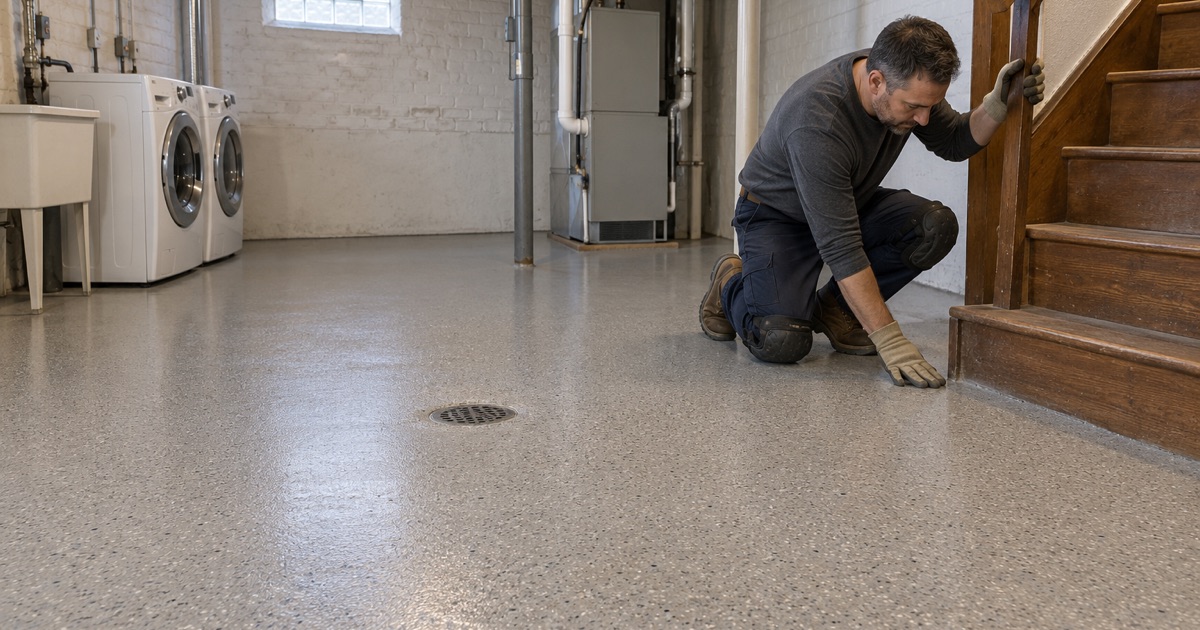
We look for tide lines on walls and stair stringers, rust at the feet of appliances and shelving, stains around the floor drain, efflorescence on the slab and the condition of the sump pit and pump. We also ask what the basement has been through, because the owner often remembers a backup that left no visible mark.
Those clues tell us whether the floor is dealing with vapor, which a mitigation primer can manage, or with liquid water and backups, which no coating can. That distinction decides the whole scope.
Moisture Testing Under ASTM F1869 and F2170
A calcium chloride test under ASTM F1869 measures how much vapor the slab surface is emitting over a set period. In-situ relative humidity testing under ASTM F2170 places probes inside the slab, set at 40 percent of the thickness for a slab drying only from the top, as a basement slab on grade does. Either result is compared against the limits of the product we propose.
An ASTM D4263 plastic sheet test is a quick screen that can catch an obviously wet slab early. It does not replace a measured test, but a sheet that fogs overnight tells us to plan for mitigation before we even pull out a test kit.
Elmhurst’s Vapor Barrier Rule and Older Basements
Elmhurst’s amendment to the 2021 International Residential Code requires a 6-mil vapor barrier under basement floors over a crushed stone base. That rule protects new construction, but 43.0 percent of the city’s housing was built before 1960, long before such a requirement. Many older basement slabs were poured straight onto soil or stone, which is why we test every one rather than assume a barrier exists.
Water, Sewers and What Comes Before the Floor
Flooding, Seepage and Sewer Backups
Elmhurst knows basement water well. The August 1987 flood damaged about 3,100 homes in the southwest part of the city, and storms between 2010 and 2013 brought street flooding and sewer backups that drove years of stormwater work. A basement with that history needs its water problem solved before its floor is finished.
After any water event, the slab must be cleaned, disinfected where sewage was involved, and dried thoroughly. We retest it after drying, because a slab that looks dry on the surface can still hold enough moisture deeper down to lift a fresh coating within months.
Overhead Sewers and Check Valves
New basements in Elmhurst must be built with overhead sewers, and the city shares half the cost of converting an older home to one, up to 5,000 dollars, or of adding a check valve, up to 3,000 dollars. If your basement has ever backed up, that plumbing work belongs ahead of the floor in the schedule, because a coating cannot stop sewage rising through a floor drain.
Sump Pits, Floor Drains and Ejector Basins
Coatings are terminated cleanly at the rim of every sump pit, floor drain and ejector basin, with lids and grates left removable for service. We never change how the floor slopes to its drains. If a pump is struggling or a pit lid is damaged, we point it out, since a reliable sump protects the new floor more than anything we apply.
Our Basement Floor Epoxy Process
Removing Paint, Glue and Old Tile
Many basement floors carry layers of paint, patching compound, carpet pad glue and old floor tile with black adhesive. Coatings will not bond reliably to any of them, so we grind everything down to bare, sound concrete before anything new goes on.
In older homes, some floor tile, black mastic and paint may contain asbestos or lead. When the age of the house suggests it, we ask for testing before removal and adjust the method to the result, rather than grinding first and asking questions afterward.
Grinding With Vacuum Dust Capture
Grinding is done with diamond tooling and vacuums attached at the machine, so dust is captured as it is made instead of drifting up the stairs or into the furnace return. Slurry and dust are never rinsed toward a floor drain or sump pit, which would send them into your plumbing and onward.
Moisture-Mitigation Primer Where the Numbers Call for It
When test results exceed the coating’s limits, a moisture-mitigation primer goes down first. It is a dense epoxy designed to resist vapor pressure from below, creating a stable base for the decorative system. It manages vapor only; it is not a solution for liquid water, cracks that leak or hydrostatic pressure.
We explain this in the proposal along with the test numbers, so you can see why the primer is or is not included. It adds cost, and it is only worth paying for when a measurement says the slab needs it.
Body Coat, Broadcast and Topcoat
Over the primer, a 100% solids epoxy body coat is applied and, for most basements, broadcast with vinyl flake or quartz for texture and color. A clear topcoat seals it and sets the sheen. Basements with little daylight can use a wider range of finishes, including metallic epoxy, because UV yellowing is less of a concern below grade.
Basement Rooms and Finishes
Laundry and Utility Rooms
Laundry rooms take detergent spills, washer leaks and the weight of appliances. A coated floor wipes clean and keeps water on the surface where it can be seen and mopped. We work around water heaters, furnaces and floor drains, leaving clearances for service and never coating over equipment pads that need to stay accessible.
Home Gyms and Playrooms
Home gyms need a floor that takes rubber mats and dropped weights, while playrooms need something that survives spilled juice and craft paint. A textured broadcast system with a durable topcoat handles both, and it cleans up with a mop instead of a carpet shampooer.
What a Basement Coating Will Not Do
It Is Not Waterproofing
A basement coating is a finish, not a barrier against flooding or seepage. It will not stop water entering through walls, cracks or the joint where the floor meets the foundation, and it will not hold back water pushed up from below. Those are drainage and foundation problems that need their own specialists.
It Is Not Radon Mitigation
In Illinois, radon mitigation is licensed work under the Illinois Emergency Management Agency, and a coating is not a mitigation system. If radon is a concern, test the house and talk to a licensed mitigator first. We never present a floor coating as a way to reduce radon.
What the Warranty Leaves Out
Coating warranties typically exclude failures caused by moisture vapor transmission and hydrostatic pressure, because those conditions come from the slab and soil. We explain those exclusions before you sign, and we name moisture first, because it is the most common reason a basement coating fails.
- 20+ Years on Concrete
- Moisture Testing in Every Scope
- Ground, Never Acid-Etched