Elmhurst Epoxy Flooring installs commercial kitchen flooring in Elmhurst, IL, serving surrounding cities including Northlake, Bellwood, Bensenville, Franklin Park and Westchester. Restaurant, bakery and institutional kitchens put floors through hot water, steam, grease, food acids, dropped pans and constant cleaning, and our 20+ years of slab preparation and resin floor work go into floors that stay sealed, cleanable and safe to stand on through all of it.
A kitchen floor also has to satisfy the health department. In Elmhurst, food establishment plan review belongs to the DuPage County Health Department, not the city, and the city’s food establishment license asks for the most recent county inspection report. We build floors to the county’s published design standards and provide the product data a plan reviewer needs.
Our proposals name the system for each area, the cove base detail, the texture, the thickness and the installation schedule, so owners and reviewers know exactly what is being installed before the first tile comes up.
What DuPage County Plan Review Looks For
Floor Finish Requirements
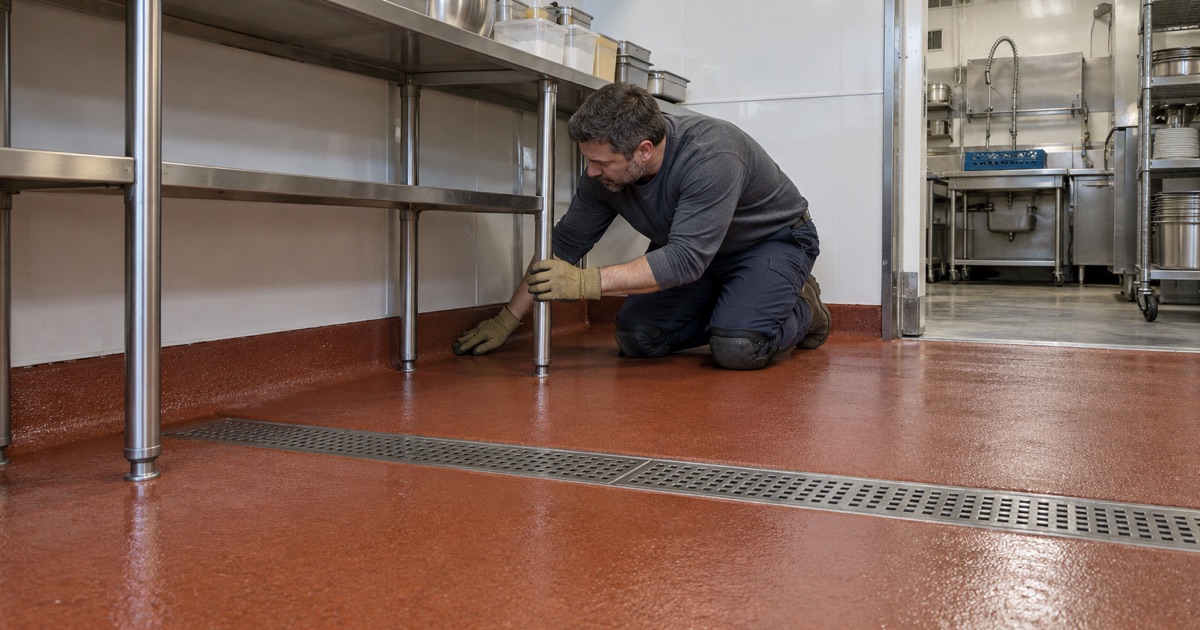
The DuPage County Health Department’s Food Service Construction and Design Manual, dated October 2025, calls for floors that are commercial grade, durable, smooth, non-slip, nonabsorbent, grease-resistant and easily cleanable. It lists sealed concrete among acceptable finishes and states that sheet vinyl will not be approved. Those standards apply in prep and storage areas, including lower levels and mezzanines.
Coved Floor-to-Wall Junctions
The manual requires a coved radius of 3/8 inch or greater and a tight seal where the floor meets the wall, and it notes that the floor finish determines the type of coving material. It even pictures an epoxy floor with a cove base. We install integral resin cove bases that run up the wall as part of the floor system, leaving no seam for water and debris.
Cove details matter most at corners, door frames, equipment legs and floor drains, where a gap lets water reach the slab. We plan each detail before installation and finish them by hand.
Walk-Ins, Wait Stations and Samples
The manual calls for walk-in cooler floor and wall junctions to be tightly sealed, and for flooring at wait stations, buffets and salad bars to extend 3 feet beyond the station. It also notes that flooring samples may need to be submitted for approval and that plan review can take up to 20 business days, so we provide samples and data early in the schedule.
Kitchen Floor Systems
Urethane Cement
Urethane cement is the workhorse of commercial kitchens. It withstands thermal shock from hot water and steam, resists many food acids and cleaners, tolerates moisture in the slab better than most epoxies and can be installed thick enough to handle dropped pans and rolling racks. It can be finished with texture for wet areas and paired with an integral cove base.
Because it handles heat so well, urethane cement is our default under cooking lines, fryers, kettles and dish areas, where an ordinary epoxy would soften, blister or debond. In a cooler or freezer, it also copes with the cold side of the temperature swing better than most coatings.
Quartz Broadcast Epoxy
Colored quartz broadcast into epoxy and sealed with a clear topcoat creates a durable, decorative, slip-resistant floor. It is well suited to dry storage, prep areas away from heat sources, restrooms and front-of-house spaces. Texture is controlled by the size of the quartz and the topcoat thickness, so grip can be matched to each area.
Integral Cove Base
A cove base troweled from resin mortar and topcoated with the floor creates a continuous surface that rises several inches up the wall. It removes the seam where dirt and moisture collect and makes cleaning simpler. It is also how we meet the county’s coved junction requirement in a single, durable system.
Heat, Grease and Water
Thermal Shock
Pouring boiling water on a floor or steam cleaning it creates sudden temperature changes that can crack rigid coatings or break their bond with the concrete. Urethane cement is designed to tolerate these shocks. We discuss your cleaning methods and water temperatures to choose the right system for each area.
Grease, Fats and Food Acids
Animal fats, cooking oils, vinegar, citrus, dairy and sugar can attack or stain some floor systems. Grease-resistant, chemical-resistant floors keep these substances on the surface for cleaning. We review the menu and processes with you, because a bakery, a pizzeria and a butcher shop each put different demands on a floor.
Drains, Slopes and Wet Zones
Kitchen floors should move water toward floor drains, trench drains and floor sinks rather than letting it pool. Where slopes are poor, we can build them up with resin mortar during installation. Drains are detailed so the floor seals tightly to the drain body, preventing water from getting under the system.
Slip Resistance in Kitchens
Antislip Floors Under the Food Code
The FDA Food Code generally calls for smooth, durable, easily cleanable floors, with an exception that allows antislip floor coverings in areas subject to moisture, flooding or spills. A textured resin floor fits that exception while remaining seamless and cleanable.
Texture Levels by Area
Cook lines, dish areas and walk-in coolers need more aggressive texture, while dry storage and front-of-house areas can be smoother to make cleaning easier. We specify texture by area in the proposal rather than applying one finish everywhere, balancing traction and cleanability.
Installing Without Losing Service
Scheduling Around Closures
Kitchens cannot easily run with part of the line out of service, so we schedule installations around closed days, holidays and overnight hours. Fast-curing systems help, and we confirm the plan in writing so staff and suppliers know when the kitchen will be unavailable.
Removing Old Tile and Preparing the Slab
Cracked quarry tile, failing grout and old coatings are removed and the slab is ground to sound concrete. Cracks and voids are repaired, and moisture is tested before the new floor goes down, because kitchens built on slabs without a vapor barrier can push moisture up from below.
- 20+ Years on Concrete
- Moisture Testing in Every Scope
- Ground, Never Acid-Etched